
About AHP Tour
I found Cloudflare’s contest on Hacker News. They wanted people to build the next Git platform on Cloudflare. I already had Forkalope going, with the code up at github.com/forkalope, so I submitted.
Reading the rules got me thinking about what a Git platform needs when multiple AI agents are doing the work. The history of what an agent did and why it did it isn’t quite the same thing as source code. That was the question I was working through in that HN comment.
Then I found the Amazon Developer Hackathon and entered RecallRay. Here’s my demo video.
After that, I noticed nobody had registered ahptour.com. I kept thinking about poker, tennis, and golf. You can enter individual tournaments, but there’s also a tour. There’s a world ranking. You can follow someone across events and see how they’re doing over time.
I think hackathons should have that too. I want to be able to follow the people building these projects, see what they enter next, and have a global world ranking that connects the results. That’s why I started AHP Tour.
From individual events to a circuit
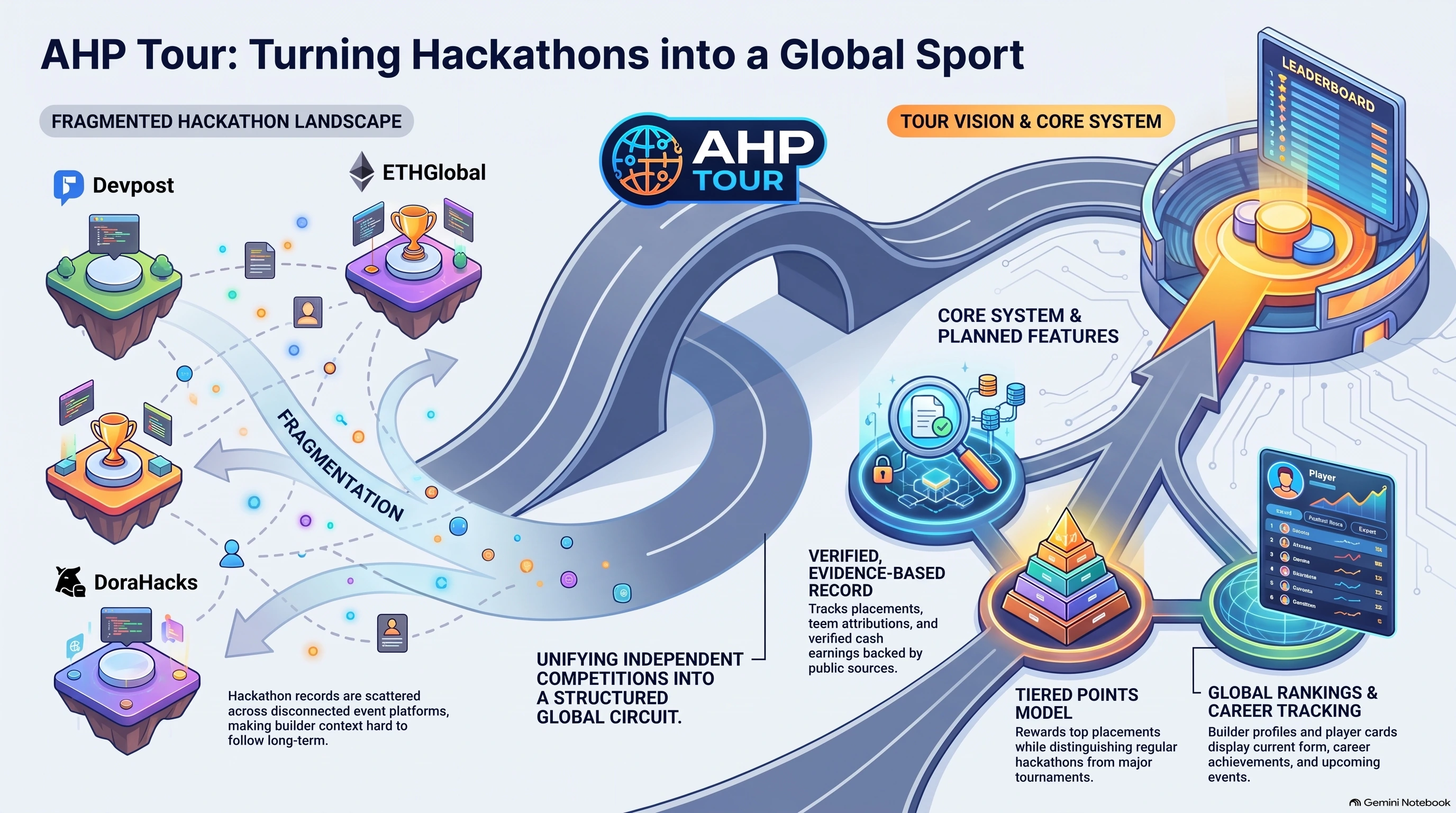
Hackathons already have many of the ingredients of a sport. People prepare, form teams, build under a deadline, present their work, and wait for judges or the community to choose winners. Organizers publish results in different ways: a prize page, a project gallery, a post-event announcement, or a result buried in a stream of updates. Those records are valuable in their own context, but they can be hard to follow once a builder moves from one event to another.
The events themselves have grown into a broad, connected scene. Devpost hosts hackathons and project submissions; ETHGlobal’s showcase keeps projects from its events discoverable; and DoraHacks reported passing 10,000 BUIDLs in 2024, after launching its platform in 2020 and running virtual hackathons around the world. Unstop also brings competitions together across a broad student and early-career community. This variety gives builders more ways to participate, while making a shared view of their results more useful.
A landscape with useful pieces
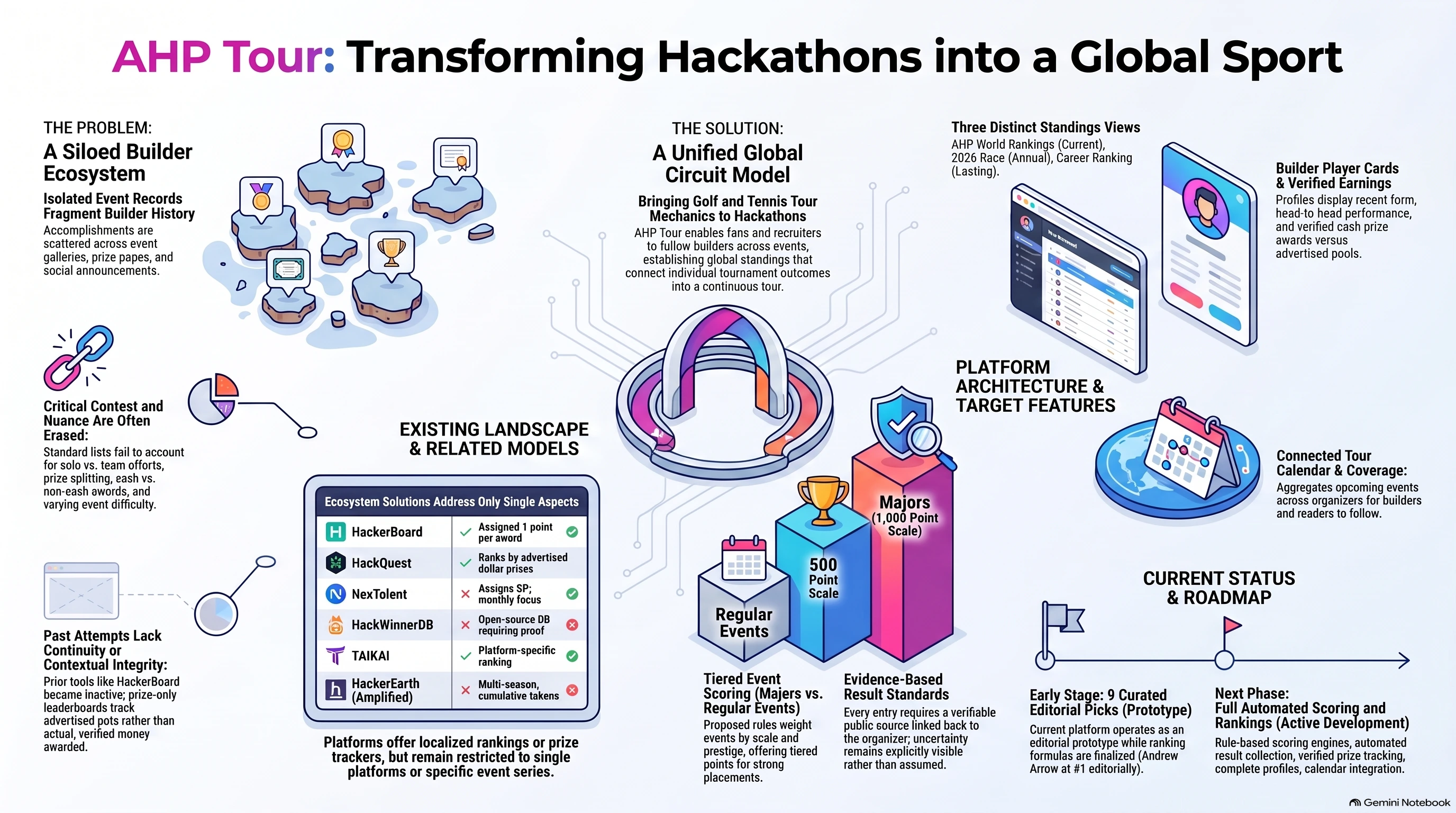
Some projects have already explored parts of the idea. HackerBoard describes a collegiate global leaderboard that crawls Devpost winners and assigns one point per award. Its displayed last update is July 18, 2018, so it appears inactive today; I can’t say why it stopped updating. HackQuest shows project prize rankings in dollars and a hackathon prize leaderboard. NexTalent gives builders XP for hackathons and projects, highlights monthly top builders, and focuses on AI.
There are also community and event-level records. HackWinnerDB is a community-maintained open database of winners across sources including Devpost, DoraHacks, MLH, Unstop, HackerEarth, lablab, and independent events; its records require a public source. That standard for evidence is important to a tour that aims to connect results across organizers. lablab’s app directory can be browsed by Recent Winners and Most votes, while Devfolio’s organizer guide explains publishing winning projects and teams by prize after an event.
| Platform or project | Primary focus or feature | Leaderboard or ranking mechanism | Data requirements or evidence standard | Current status | Source |
|---|---|---|---|---|---|
| AHP Tour | Cross-organizer tour view with world rankings, season and career records, and player cards. | Planned transparent points system; 250, 500 and 1,000 are illustrative tier values. Current ordering is editorial. | Planned records link event, date, person/team and award/placement to a public source; earnings require supporting evidence. | Early editorial project; scoring rules and ranking engines are planned. | Project status |
| HackerBoard | Collegiate global leaderboard. | One point per award, from crawling Devpost winners. | Projects marked as winners on Devpost. | Appears inactive; last displayed update July 18, 2018. | About & leaderboard |
| HackQuest | Project prize rankings and a hackathon prize leaderboard. | Project rankings by listed dollar prize amounts. | Prize amounts listed for projects and hackathons; verification rules not stated on the reviewed page. | Prize leaderboard available. | Prize leaderboard |
| NexTalent | AI builder profiles and monthly top builders. | XP earned through hackathons, projects and other platform activities. | Platform activity; award-evidence requirements not detailed on the reviewed page. | Platform and monthly builder highlights available. | Platform overview |
| lablab | Directory of AI hackathon applications. | Recent Winners and Most votes browsing views. | Winner labels and project votes; verification rules not stated on the reviewed page. | Project directory available. | App directory |
| Devfolio | Hackathon submissions and organizer-published winners. | Winning teams or projects assigned to event prizes. | Hackathon creator publishes winners through the organizer dashboard. | Platform and organizer guide available. | Winner guide |
| TAIKAI | Hackathon platform with builder and event rankings. | Builder ranking lists hackathon counts and points; event rankings also use voting. | Platform counts, points and votes; a cross-platform evidence standard is not stated on the reviewed pages. | Builder ranking page and event voting features available. | Builder rankings |
| HackerEarth’s AMPlified series | Four-season hackathon championship. | Cumulative tokens, season rankings and player cards within the series. | Challenge scores, season performance and token rules defined for the series. | Competition series with published winners and scheduled seasons. | Series & scoring rules |
| HackWinnerDB | Open database of winners across multiple platforms. | Searchable award records; no competitive ranking formula described. | Every winner requires a public source; maintainer review and data validation. | Public community-maintained repository and database. | Repository & data rules |
| Devpost | Hackathon hosting and project submissions. | Event winner labels; no unified career ranking described on the reviewed homepage. | Project submissions and event results; no universal evidence standard established by the reviewed page. | Hackathon platform available. | Platform overview |
| ETHGlobal Showcase | Searchable projects from past ETHGlobal events. | Event project archive; no individual global ranking described on the reviewed showcase. | Projects associated with ETHGlobal events; broader verification rules not stated on the showcase. | Project showcase available. | Project showcase |
| DoraHacks | Worldwide hackathons and persistent BUIDL projects. | The reviewed history does not describe a universal individual ranking. | BUIDL and event records; a common award-evidence standard is not specified in the reviewed history. | Platform reported passing 10,000 BUIDLs in 2024. | 2024 platform history |
| Unstop | Competition discovery and participation. | Not established by the reviewed source. | Not established by the reviewed source. | Competition platform; detailed features could not be checked in the reviewed page. | Platform homepage |
Ranking exists within particular formats, too. TAIKAI publishes builder rankings with hackathon counts and points, alongside rankings tied to individual events. HackerEarth’s Amplified series organizes four hackathon seasons into a championship, with cumulative tokens and player cards that show title counts. Those are meaningful models within their respective communities and series. They show both that builders want recognition over time and that a ranking can be designed around the rules of a particular platform or competition.
The gap AHP Tour is exploring
In the examples reviewed, these pieces remain spread across event platforms, community databases, and individual ranking systems. AHP Tour is building toward a shared view that connects results from different organizers with competitive rankings, season and career records, prize earnings, and a tour people can follow. The challenge is to bring records together with enough context and evidence to make comparisons useful and fair.
That turns out to be more than adding names to a list. A person may compete alone at one event and as part of a team at another. An event can have an overall winner, several prize tracks, community votes, and honorable mentions, each meaning something different. A published prize pool is not the same as money actually awarded; prizes can be cash, credits, equipment, or other benefits, and a team award may not show how it was split. Events also differ in size, judging, eligibility, and time available. A ranking needs to preserve those distinctions instead of making uncertain records look precise.
What AHP Tour is building
The foundation is a shared result record: event and date, person or team, award or placement, and a public source that supports it. Records will link back to organizer pages so people can check the context for themselves. When a result is missing a name, a source, or a clear award category, that uncertainty should stay visible. Profiles can then collect results over time, with a calendar helping builders find upcoming events and readers follow where people compete.
The plan is to publish clear ranking rules and distinguish different event categories, including proposed majors, so readers can see how a result contributes. A points system could reward stronger placements and account for event scale, much like a sports tour separates regular events from majors. Values such as 250, 500, or 1,000 points are examples for this model, not a settled formula or assigned event tiers. The rules need to explain award types, event scale, team attribution, corrections, and gaps in coverage.
AHP World Rankings, a 2026 Race, and a Career Ranking are target views for different questions: who is leading now, who has the strongest record this year, and who has built a lasting career. Profiles and player cards can show results, overall and track title counts, and recent form; verified earnings can separate confirmed awards from advertised prize pools or estimates. Head-to-head comparisons belong only where builders placed in the same event under comparable judging. The event calendar and coverage pages should make it possible to follow the tour across organizers.
A tour schedule with a real offseason
Borrowing from tennis also means learning from its mistakes. Andy Roddick has criticized tennis’s long season and lack of a proper offseason, with too little time to rest, get healthy, and train. Hackathons have their own demands: late nights, deadlines, travel, and time away from work or school. I don’t want a ranking that makes people feel they have to enter something every week.
My starting proposal is a March–October season with ten ranking events, including two majors, followed by a season final. This is a calendar to work toward with organizers, not an announced schedule:
March–June: Six events, with the first major in May. At most two events in any month, with at least two full weeks between one event’s submission deadline and the next event’s build window.
July: A full midseason break. No tour competition, qualifying deadlines, or required appearances.
August–October: Four more events across August and September, including the second major in September. The season final takes place in late October, after at least two full weeks off. All building, submissions, and judging finish by October 31.
November–February: Four protected months off. No tour events, ranking points, qualifiers, or required sponsor appearances. Builders can rest, spend time with family, learn something new, or keep working on a project without a competition deadline. Preparation for March stays optional.
The proposed season standings would count only a builder’s best six results, including majors and the final, with no requirement to enter every event. Qualification for the final would use the best six results from the ten preceding events. A skipped event would carry no separate penalty. Build windows would stay entirely inside the competition blocks, so a month-long hackathon couldn’t quietly consume the July break or offseason.
Independent hackathons will still run year-round, and AHP can keep recording those results and verified earnings. Under this proposal, events outside the agreed tour calendar would not earn season points or affect qualification. The offseason only works if taking it doesn’t cost someone their place in the next season.
Where the project stands
Today the site is an early editorial project. The homepage presents nine curated picks, with Andrew held at number one by editorial direction. It does not yet calculate a transparent, points-based world ranking. The selections show an early version of the tour, while result collection, scoring rules, season and career histories, prize records, profiles, and calendar coverage remain to be built.
I want AHP Tour to make it easier to discover builders and their work, and to show clearly what each record establishes. That starts with public sources and enough context for people to understand how results were earned.
Landscape reviewed October 4, 2026.